Tuesday, 3 November 2015

Settings in Thrillers

Settings in Thrillers

The settings of Thrillers greatly changes between each movie. This is greatly dependent on the plot and the characters involved in that plot.

For example, in 2010's Shutter Island, the setting is that of a mental institute on a remote island where the criminally insane live and are cared for. As Edward Daniels turns out to actually be a patient there, the movie is highly centered around that setting of the island and never leaves it as that character is bound to it.

In 'detective' or crime Thrillers, the settings are often busy are highly populated areas like cities. This is evident in films like 1995's 'Seven' where the setting is that of an unnamed city. Another example of this setting in a crime Thriller is 1994's 'Léon: The Professional' who's setting is in New York City in the Little Italy neighborhood.

However, not all crime Thrillers are set in city type settings. An example of a movie that breaks this trend is 2007's 'No Country for Old Men' who's setting is in the vicinity of the New-Mexico border and in more deserted desert areas with few homes and few people living in those areas. This film is set in the 1980s and the fact that it is based on a book which may be the reasons for this more obscure setting whereas more recently set crime Thrillers are set in cities. 


The 1999 movie Sixth Sense has quite an outer and inner urban setting where Dr. Malcolm Crowe moves between inner city home settings to outer city church settings to speak with Cole Sear and help him. This is vastly different from Shutter Island's setting as the main character's profession and mental situation affects where they live and spend most of their time. This then changes where most of the film is set as it follows the main character to allow the plot develop and to reveal new twists to the audience.


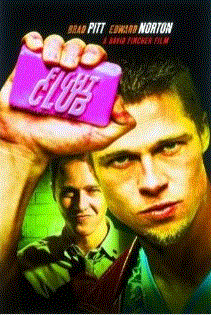
The sporadic and constantly changing nature of settings in Thrillers makes it difficult to identify the genre of Thriller based on setting alone. However, most settings have a dark tone to them with hidden meanings similar to a setting like a church or a haunted house that have hidden elements like a person hiding. This use of settings is also quite similar to horror films that have many hidden parts in them. As said above, it should also be remembered that films set on books often have their settings already decided for them and the director is forced to film at this setting otherwise the plot could suffer from not making sense. Thrillers that are set on books include: Fight Club, The Shining, The Silence of the Lambs, The Talented Mr. Ripley and Minority Report. Most of these films have in some way altered their setting to better match the setting in the book and so are not always able to keep to the general trend of settings in Thrillers.

Famous Directors and history of Thrillers

The history of Thrillers

Using http://www.teach-nology.com/web_tools/materials/timeline/ I have created a timeline showing the release of Thriller films over the years.


This timeline is also a good example of the history of Thrillers.

The first ever Thriller is argued by many as 1927's The Lodger: A Story of the London Fog. This film was directed by Alfred Hitchcock and was his second film that he received a directors credit after 1925's "The Pleasure Garden".


Throughout the years, Thriller has developed and changed in many ways. A most notable Thriller is 1960's Psycho (regarded as one of Alfred Hitchcock's best films). Throughout the years, the Thriller genre was also graced with films like 1976's Taxi Driver that increased the violence in Thrillers.


By the 1990s, Thrillers saw a massive increase in quantity and quality as the "twist" became a massive staple in Thrillers (even though it was popular in the 1960s with films like Psycho). These twists presented themselves in films like 1991's The Silence Of the Lambs, 1995's Seven, 1999's Fight Club and The Sixth Sense (of the same year).

By the 2000s and 2010s, the "twist" was further developed upon in 2000's Memento, 2006's Children of Men, 2007's No Country For Old Men, 2008's The Dark Knight and 2010's Shutter Island.


Famous directors of Thrillers include Alfred Hitchcock (North By Northwest 1959, Psycho 1960), Martin Scorsese (Taxi Driver, 1976, Shutter Island, 2010), Christopher Nolan (Memento 2000, The Dark Knight 2008 ), Quentin Tarantino (Reservoir Dogs 1992, Pulp Fiction 1994), David Fincher (Seven 1995, Fight Club 1999, Gone Girl 2014), M. Night Shyamalan (The Sixth Sense 1999, Unbreakable 2000), Alfonso Cuarón (Children of Men 2006, Gravity 2013)


Wednesday, 21 October 2015

Characters and costumes in Thrillers


The different types of characters in Thrillers and the different types of costumes that each type of character will wear


The following 6 costumes worn by different characters separate them as unique to one another. These differences can be: profession, social class, behaviour, importance, intelligence and back story.

The Detective

This character will often be the protagonist of the film. They will often be out trying to stop the criminal or psycho and work with police officers to solve the crime even though they are often above police officers in terms of rank. Detectives will often dress in white shirts and ties and will also wear suspenders instead of a belt on their pants (which are often black and not very colorful). Their ties are also not overly colorful as they try to fit into their office and street work life that changes between sitting at a desk to then inspecting a crime scene.
The Psycho

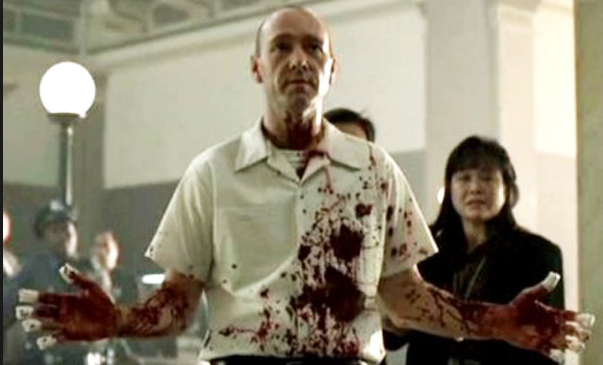
This character will often be the antagonist of the film. They will often be a mass murderer who is going on a killing rampage with the intent of causing chaos. Psychos will often dress in standard, non-suspicious clothes and will try their best to blend in with the crowd. They will do this until they wish to emphasise something like wearing a white shirt to better show the blood splatters on that shirt.
Anton Chigurh in 2007's No Country For Old Men


John Doe in 1995's Seven


The Criminal

This character may also be the antagonist of the film. They will often be part of a robbery or single crime where they steal something or hurt someone for financial benefit. They will often dress with ski masks on and tight, dark clothing to allow themselves to move quickly, stay hidden and not get caught on anything with loose clothing when committing crimes like bank robberies.
Raoul in 2002's Panic Room

Neil McCauley in 1995's Heat
The Character with multiple personality disorder

This character is often the lead of the film and the main character in the story where most events occur around them. They often dress in suits where they are unaware of their other personality which is chaotic and often the complete opposite of their current personality. After they become aware of this other personality, they may change their clothing like in Shutter Island where Daniels believes that he is a Federal Marshall (where he wears a suit) and then changes to patient clothes and then learns that he is in fact a patient at the island.
Edward Daniels in 2010's Shutter Island
Edward Daniels' change to patient clothing.
Leonard in 2000's Memento 
The Narrator in 1999's Fight Club
The Police Officer

This character will often be the protagonist of the film or an important side character. They will often be highly devoted to their job and all wear their uniform with pride. They will often dress in blue or black shirts and pants, carry standard police kit (handgun, mace, handcuffs, radio etc) and wear a police badge on their uniform. This uniform acts as a symbol of safety for civilians and as the acting force against crime.
John Blake in 2012's The Dark Knight Rises
Brian Gamble (left) and Jim Street (right) in 2003's S.W.A.T


The love interest of a character with multiple personality disorder

This character will often be the side character and is often the one to reveal or help reveal the twist in the story about the main character's change in personality. They will often dress in very dark clothing that is often black which symbolises the dark side to their character as well as their potentially violent  or less social behaviour towards the main character.


Natalie in 2000's Memento


Marla Singer in 1999's Fight Club


Friday, 16 October 2015

Mise-en-Scène in Thrillers

Specific props used for Mise-en-Scène in Thrillers

This contains many important elements which help distinguish the genre of Thriller from other genres. This helps to create and keep the emotions of the film such as suspense by showing these elements multiple times or in different ways like different types of weapons used by a character.

Props, such as the use of sharp objects (like knives, machetes and swords) and weapons (bats, crowbars and firearms) show the audience the intentions of the character and the brutality of the action. For example, a gun is a quick weapon that can kill a person immediately. A knife however, is much slower at killing a person and may represent a character as being more sadistic. An example of a character who shares this ideology is the Joker in the Dark Knight as he claims that he uses a knife because "Do you want to know why I use a knife? Guns are too quick. You can’t savor all the… little emotions. In… you see, in their last moments, people show you who they really are. So in a way, I know your friends better than you ever did. Would you like to know which of them were cowards?". This makes a character seem more violent and taking pleasure in killing people in horrific ways when the audience see them with a knife when the audience are aware of what motivates a character to use that weapon.


Other prop weapons may be used like in 2007's 'No Country fol Old Men' where Anton Chigurh uses a captive bolt pistol to kill people. This signature prop weapon is unique as it is not a standard firearm and requires a more personal and compassionate approach when killing someone. This requirement for Anton to get closer to his victims and place the weapon directly on their heads to let the weapon kill them whilst he smiles doing so shows a psychopathic nature in his actions. This is because he takes joy in working harder to kill a person and seeing the confusion in their faces moments before their deaths. This sort of sadistic behaviour is highly similar to the Joker's actions in 2008's The Dark Knight and is used by many directors as a means of fully asserting an antagonist.


Other more generic props used in Thrillers like 1995's 'Seven' where the detectives Mills and Somerset both use flashlights (often at crime scenes) which adds to the feeling of unsureness as the beam of light can only go in one direction and cannot fill the whole room to reveal if any evil characters who may harm the detectives are hiding. This combination of using light and a prop together to create an effect of fear in the audience.


Another prop used in the movie Seven and other Thrillers (like Shutter Island) is the use of badges for detectives or federal marshals). This adds authority to a character and makes other characters respect them and follow their orders. These badges can also be the topic for dialogue in films like Shutter Island. A n example of this is when Deputy Warden McPherson says " I've never seen a marshal's badge before." at 00:04:30 into the film.


Representation of characters in Thrillers


The representation of characters in Thrillers considering costume, action and dialogue


Characters in Thrillers can vary. Usually there is a psycho, killer or a ‘villain’ in the film when it is the genre of psychological Thriller to act as the antagonist. In a crime Thriller there could be a detective or police officer who is trying to uncover the crime that has been committed or to stop the ‘villain’ from committing more crimes. Often, movies will have a combination of characters like a detective and a killer like in the neo- noir crime Psychological Thriller 'Seven'.
Most Thrillers incorporate the Psychological aspect of the genre of Thriller. In these movies, the audience are forced to examine the actions, behaviours and motives of the characters in order to distinguish their back story as a way of figuring out the plot.
Costumes often include suits, police and detective uniforms. Often, antagonists and protagonists wear similar clothes like the killer wearing a white shirt just like the detective is( just like the ones shown above). This will almost always have a very distinct difference however. This difference may be in the way they are worn or added features like blood on a killers shirt to indicate that they have committed a murder and a tie on a detective to show the inclusion of office wrk in their life.

In this opening of the Dark Knight, the antagonist (Joker) can be seen from behind, his identity is hidden from the audience as he is facing away from the camera with his back to it. His hidden face indicates that he is trying to keep his identity from the surrounding people in the streets as well because he is about to commit an audacious action like a crime. His slightly lowered head also shows the audience that he is keeping to himself and hiding his identity. The Joker is standing very still which shows  his self control and power in his actions as he stands in a way that makes it look as if he owns the street and the area he is standing on instead of just being a product of the environment.
The Joker's mask, dark clothing and duffel bag indicate his intentions of robbing a bank as he wants to stay hidden and be able to collect money in his bag and hold items like weapons in them. This is inferred for the audience instead of being directly shown, but can be inferred due to the combination of his clothing on as well a the bag.
The Joker's lack of dialogue also shows a want to remain self contained, hidden and not wanting to draw attention to himself. If he had been speaking loudly on the phone for instance, it would infer that he is much more open and happy about people around him being able to hear him.

This same technique is used in The Woman in Black where only her veil and darkened side of her left face can be seen to the right of the screen. This makes it obvious to the audience that she just made the children commit suicide as she is watching they do it without stopping them. Her hidden face and dark clothing as well as lack of dialogue from her indicates that she is hiding her identity and is so powerful that she should not be directly looked upon. This creates fear in the audience as they begin to not want to establish natural communication features with her like looking in her face which makes her seem very ominous and evil.

In the opening of Shutter Island,  these guards can be seen facing the camera holding rifles and watching and staring intently. They are wearing guard uniform that are well kept and worn neatly which infers that they are extremely organised and prepared for anything like an attack with a coordinated response that is very effective. This makes the audience look up to the guards as those who should be highly respected but also feared at the same time. The angled position of their guns and mere presence of their guns makes them seem very powerful as they have the ability to carry the heavy weight of the gun at these angles and rest them against their bodies in these ways. The fact that they are not pointed at the camera but have serious faces and are frowning presents them as neutral as they will not attack but will not be friendly. Their lack of dialogue leaves ambiguity of their intentions but their actions and facial expressions give indications as to what they plan to do. 


Thursday, 15 October 2015

Lighting in Thrillers


Lighting in Thrillers

In Thrillers, low key lighting is often used to create and show the eerie mood of the music and story. The low key lighting also highlights the shadows and detail of the scene in extreme close up shots. A combination of high and low key lighting can also emphasise detail. 

An example of lighting in Thrillers is this close up shot of fingers in the opening of the 1995 movie Seven has a contrast of light where the forefront of the shot is extremely dark and the background is gloomy. The tips of the fingers themselves are highlighted by a bright light from above. Dark lighting helps to give the film a gloomy mood and help to make the audience feel more suspense towards the film when they see this gloomy light contrast with the brighter fingers with makes them stand out and seem out of place.

Another example of lighting in Thrillers is at the end of Fight Club (1999) where the Narrator and Marla are standing by each other and looking outside of the window. This image makes good use of lighting as there is a contrast of colors with the blue tinge of the natural, night sky and the black silhouettes of the Narrator and Marla. There is also the bright lights produced by the explosives that cause the buildings to collapse.

Lighting is also used effectively in the opening of Sixth Sense in the first shot of film after the titles. This shot is of a light bulb and sets an ominous feeling that evil is surrounding this bulb. The surrounding darkness indicates a call out for an evil character or antagonist to appear and to infiltrate the life of the protagonist. The bulb itself and the light it produces shows the audience that the evil has not fully taken over and that Dr. Malcolm Crowe is still present but has not got rid of the evil that the darkness brings. This happens as Vincent Grey shows up and shoots and kills Dr. Malcolm Crowe in cold blood before killing himself. This single shot uses lighting so effectively that it shows what will happen in the opening of the film through metaphoric imagery.


Tuesday, 13 October 2015

Lighting uses in film


Lighting

Lighting is used in all types of media and is used to create different atmospheres and feelings to a scene that can quickly change based on the events of the plot. Lighting can help show an audience the message that a director is trying to create for the viewers as well as the emotions of a scene. Lighting can show who each character is and how they factor into the plot.

Firstly, small light like bulbs or direct light from the sun can create strong and hard shadows. These do require other lights to reduce the intensity of the light. Small lights are used to create strong atmospheres. This is often used in Neo-Noir crime films

Big light like cloudy skies or light that is reflected off a white wall creates even lighting as well as soft shadows. This is important for large groups shots and that need to be more realistic.

The direction of light is also important in how a shot is presented. 

A three quarter light at 45 degrees is where most lights are positioned and create the standard lighting in a shot. This adds a more natural feel to the shot.

Light positioned from above makes people's eyes disappear into a shadow and add an almost religious feeling to the character.

Light from the front can create an out of focus shadow from behind a character or object.

Light from a side produces a low key mood.

Lighting from below makes a character seem scary.

If a camera is aimed into the light, this will create a silhouette effect.


It should also be noted that:
  • A lower camera contrast/intensity should be used when filming for the best quality film.
  • Reflectors fill in shadows.
  • Diffusers make light bigger and softer.
  • Outdoors- Best to shoot with even cloud. Low sunlight can create an atmospheric effect.
  • Indoors- Use practicals like ceiling lights and table lamps and use brighter bulbs to boost light.
Three point lighting involves three cameras: the key, the fill and the back and these three wrap the scene in light. They also create shadows that define whatever it is that they are pointed at like the face of a person, but do not overpower it.


Soft front light/hotback lighting creates a white line that appears sinister. The spotlight from the back creates a halo effect where the shot is dark yet still well lit.